

JT
May 26, 2026
How to Monitor Your Recovery (Without Guessing)
By Jerry Teixeira | Nearly 30 Years of Strength Experience
(This is part 2 of a 3-part series on recovery and training. If you missed part 1, read it here.)
The 60-Second Morning Check: Resting Heart Rate
Tool #1: Resting heart rate, measured first thing in the morning before you get out of bed.
Here's the protocol. Wake up. Stay lying down. Take 10 slow, deep breaths through your nose. Find your pulse on your wrist or neck. Count the beats for 60 seconds. That's it. Write the number down.
The 10 breaths matter. They bring you to a consistent baseline so you're comparing apples to apples day over day. If you check RHR right after a stressful dream or after your alarm jolts you awake, the number is going to be inflated.
Do this every morning for two weeks and you'll have a baseline. For most adults, resting heart rate lands somewhere between 55 and 75 beats per minute. Your specific number matters less than your personal trend over time.
Once you have a baseline, the information becomes useful. If your RHR is consistently 2-3 beats above your baseline for several days in a row, something is up. If it spikes 5 or more beats above your normal, your body is telling you it's under significant stress. Could be a training load issue. Could be work stress. Could be the early stages of getting sick. Could be all three.
The point isn't to diagnose why. The point is to have an early warning signal that says "back off today" before your body forces the issue with an injury or illness.
What to do with the information is straightforward. If your RHR is at or below baseline, train as planned. If it's a few beats elevated for a day, not a big deal. Train but maybe pull back on intensity. If it's elevated for three or more days running, that's a pattern. Drop the intensity, cut the volume, prioritize sleep, or take a full rest day. If it spikes hard, skip the session. Go for a walk instead.
This isn't complicated. But it's remarkable how few people actually do it. Most of us just show up and train based on the calendar. Monday is Monday so we train. But Monday after a weekend of terrible sleep, a sick kid, and a Sunday night spent finishing a work presentation is a very different Monday than one where you slept eight hours and had a quiet weekend.
Your body knows the difference. Your schedule doesn't. RHR bridges that gap.
One thing to keep in mind: resting heart rate is a blunt instrument. It tells you something is off, but it doesn't tell you much about what or how much. For that, you need heart rate variability.
But blunt instruments still work. You don't need a scalpel to know you shouldn't train hard when your body is screaming at you to rest. You just need to listen. And RHR gives you something concrete to listen to instead of guessing.
Two fingers. Sixty seconds. Every morning. It's the simplest habit that will make the biggest difference in how you manage your training over the long haul.
The Deeper Metric: Heart Rate Variability
If you own an Oura ring, an Apple Watch, a Whoop, or a Garmin, you're sitting on a more powerful metric and there's a good chance you're either ignoring it or misreading it. Tool #2, Heart rate variability. HRV.
The name sounds like it measures how variable your heart rate is, and technically it does, but that undersells what it's actually tracking. HRV measures the variation in time between individual heartbeats. Not beats per minute, but the millisecond gaps between each beat.
Why that matters: a healthy, recovered nervous system doesn't fire like a metronome. There's natural variation between beats. When your parasympathetic nervous system (the rest and recovery side) is active, variability is high. When your sympathetic nervous system (fight or flight) is dominant, variability drops. The beats become more rigid and uniform.
High HRV generally means your body is recovered, adaptive, and ready to handle stress. Low HRV generally means your body is still processing a stress load and has less capacity to take on more.
The key word is "generally," because the single most important thing to understand about HRV is that you don't want to overreact to any single day's reading. HRV is noisy. It's influenced by alcohol, hydration, meal timing, room temperature, sleep position, even what time you went to bed. A single bad night can tank your score. A single good night can inflate it. The daily number is real data, but the trend over days and weeks is where the actionable information lives.
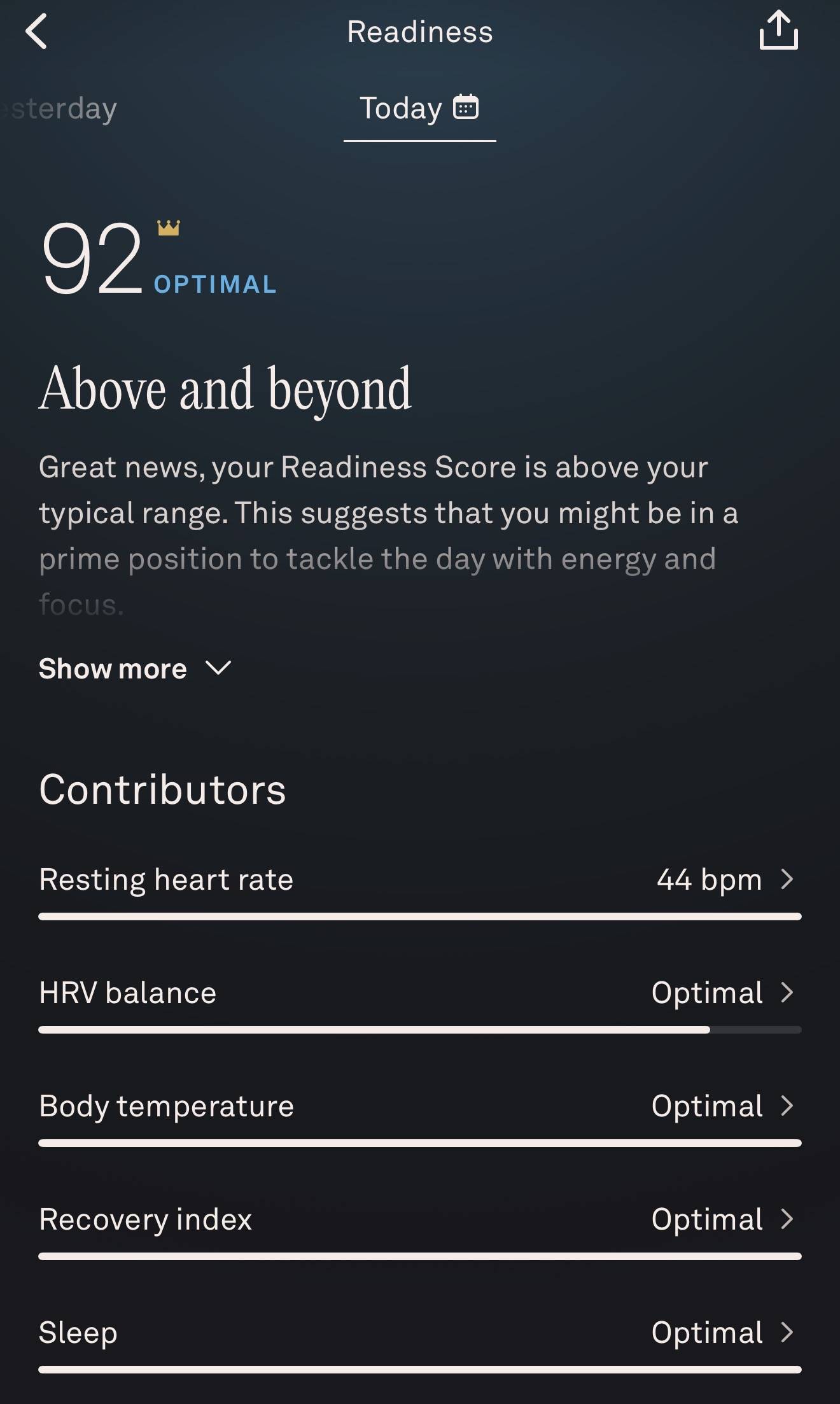
Every wearable presents this differently. Oura gives you a readiness score that factors in HRV alongside sleep and body temperature. Apple Watch shows HRV in the Health app but doesn't interpret it for you. Whoop gives you a recovery percentage. Garmin calls it Body Battery.
Regardless of platform, here's how to actually use HRV data:
Look at your 7-day and 30-day averages, not today's number. If your 7-day average is trending down over two or three weeks while your training load has stayed the same or increased, your cumulative stress is outpacing your recovery. That's the signal to intervene before your body does it for you.
If your 7-day average is stable or trending up, you're recovering adequately. Keep doing what you're doing.
If your baseline HRV has been gradually declining over months, that's a bigger conversation. Something systemic is off: chronic sleep debt, unmanaged work stress, overtraining, or a health issue worth getting checked out.
What HRV won't tell you is what to do about it. It's a dashboard light, not a mechanic. It says "something needs attention." It doesn't say what. That's where practical recovery strategies come in, which is what part 3 of this series covers.
I wear an Oura ring every day, and have an Apple Watch (which I wear in airplane mode). I've tracked my HRV for years. The single biggest lesson I've learned from it is that sometimes, on days when I feel like pushing hardest, the data says to pull back, to make it a low intensity day. And when I started listening to the data instead of my ego, I stayed healthier and made better long-term progress.
But the wearable isn't magic. There are still days where I train hard when the device says not to. Your device is a second opinion that doesn't have an ego. And for anyone over 40 juggling training with the rest of life, that second opinion is worth having.
Stay capable,
JT
Ps. I'll talk about how I use these data in my next post, stay tuned.
(This is part 2 of a 3-part series on recovery and training. If you missed part 1, read it here.)
Want the system I use to train at home with recovery built in? Download the free Foundational 8 guide.
About Jerry Teixeira
Jerry Teixeira is the founder of Bodyweight Strength and has been physically training for nearly 30 years. Jerry has coached thousands of clients using the Minimum Effective Dose (MED) philosophy—maximizing results through surgical precision and leverage manipulation rather than high-volume "junk" training.
Frequently Asked Questions:
I don't have a wearable. Is resting heart rate alone enough?
For most people, yes. RHR gives you a reliable daily signal about whether your body is recovering or accumulating stress. It won't tell you everything, but it will catch the big stuff. A wearable adds depth with HRV data, but plenty of people manage their training intelligently with nothing more than a morning pulse check and honest self-assessment.
What's a "good" resting heart rate?
There's no universal number to aim for. Trained adults typically fall between 50 and 65 bpm, but your baseline is what matters, not a comparison to someone else. A person with a baseline of 62 who sees a spike to 70 is getting the same warning signal as someone with a baseline of 50 who spikes to 58. Track your own number and watch your own trend.
No. HRV is highly individual. It varies by age, genetics, fitness level, and even the device measuring it. A 35-year-old endurance athlete and a 52-year-old desk worker will have completely different baselines. Comparing your HRV to someone else's is meaningless. The only comparison that matters is your number today versus your own trend over the last 7 to 30 days.
No. A single low day is just data. It could be from a glass of wine, a late meal, or a bad night of sleep. One low reading means pay attention, maybe dial back intensity, but it doesn't mean stop. A downward trend over several days or weeks is when you need to intervene. One red day on your app is noise, but five in a row is a signal.
Before. Before coffee, before getting out of bed, before checking your phone. The protocol is: wake up, stay lying down, take 10 slow deep breaths through your nose, then count your pulse for 60 seconds. Anything that raises your heart rate, caffeine, standing up, reading a stressful email, contaminates the reading.
Both are measuring the same thing but potentially at different times and using slightly different algorithms. Pick one device, use it consistently, and track the trend from that device. Don't compare numbers across devices. The value is in the trend from a consistent source, not the absolute number.
Two weeks of consistent daily tracking. That gives you enough data points to see your personal range and start recognizing when something is off. After a month you'll have a solid feel for what's normal for you and what's elevated.
Absolutely. Illness can elevate RHR and suppress HRV for days or even weeks after symptoms resolve. If you're recovering from a cold, flu, or any infection, expect your numbers to be off and don't rush back to hard training based on how you feel. Let the metrics return to baseline first. In my experience, elevated RHR from illness can linger for up to three weeks.