
How to Stay Lean After 40 Without Bulking or Cutting

JT
Nov. 25, 2026
How to Stay Lean After 40 Without Bulking or Cutting
By Jerry Teixeira | Nearly 30 Years of Strength Experience
Most advice for staying lean after 40 comes in two flavors: cut hard to drop fat, or bulk to build muscle. A lot of people end up bouncing between the two for years.
I don't do either. I'm 47, I train Jiu Jitsu and strength, and I stay lean by eating close to what I burn, most days of the year, with meals I don't have to think about.
This post shows you exactly what that looks like: what I eat on a normal day, the few principles behind it, and how to set up something similar that fits your body.
Why bulking and cutting backfires after 40
The classic approach is to eat in a big surplus to build muscle, then diet hard to strip off the fat that came with it. It can work when you're young. After 40, it works against you.
You build muscle more slowly than you did at 25. Strength gains after 40 hold up well, but in one study, people aged 45 to 55 added far less muscle from 20 weeks of lifting than people in their 20s did. So a big surplus sends more of the extra to fat.
And where that fat ends up matters. A study of 59,269 adults found that fat around the organs and fat marbled into the muscle tracked with worse blood sugar and more metabolic syndrome, even in people carrying plenty of lean mass. I covered that in detail in Part 1 of my series on turning 40.
There's a deeper reason, too. In Part 2 of that series, I explained evolutionary biologist Michael Rose's work on why your body gets less forgiving after midlife. While you're young, natural selection covers for a lot of mistakes. By midlife, that protection has mostly faded, so habits you got away with at 25, like big swings in how much you eat, start to cost more.
The cutting phase has its own cost. Hard diets tend to eat into muscle along with fat, and the harder and longer you diet, the more you risk losing.
So instead of swinging between the two, I aim for steady: enough food to fuel training and hold muscle, not so much that the extra piles up as fat.
What I eat on a normal day
Eighty-five to 90% of my meals are some version of these four. I start the day with an espresso, then rotate through them.
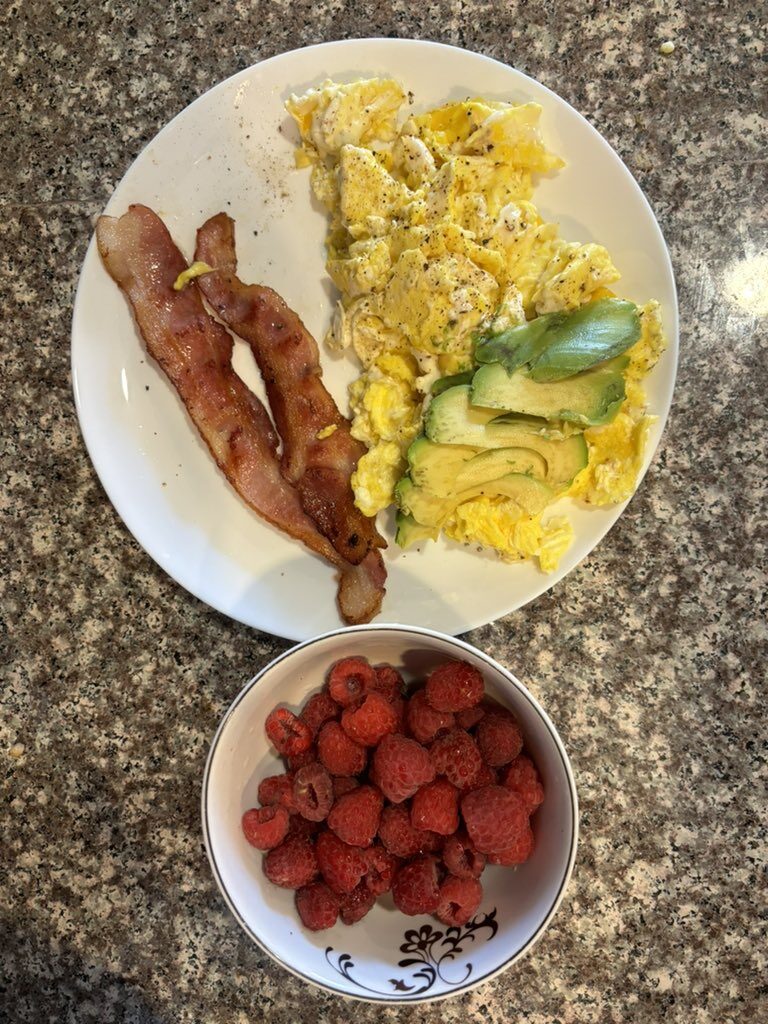
Scrambled eggs with avocado, two strips of bacon, and berries. I use pasture-raised eggs, and the avocado adds fat and fiber.
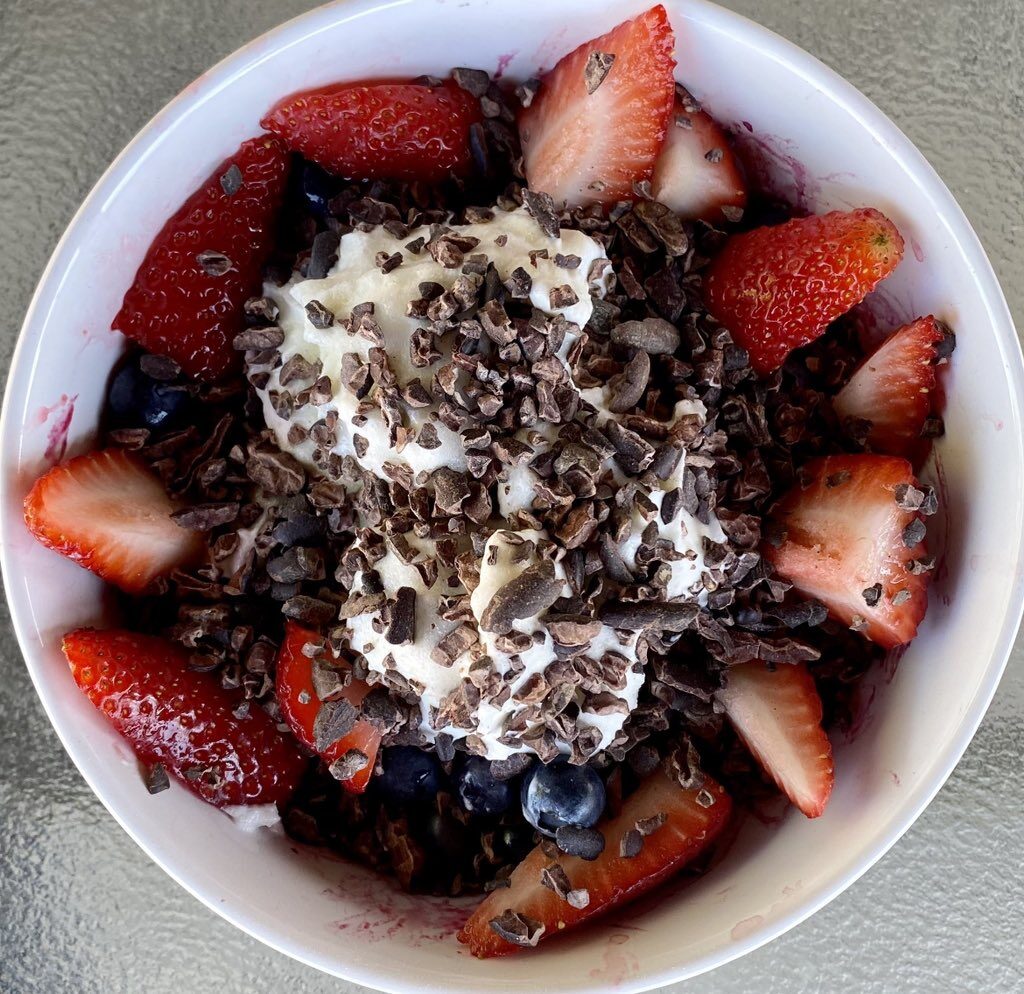
Greek yogurt with berries and cacao nibs. Fast, high in protein, and the berries and cacao bring a lot of plant compounds for very few calories.
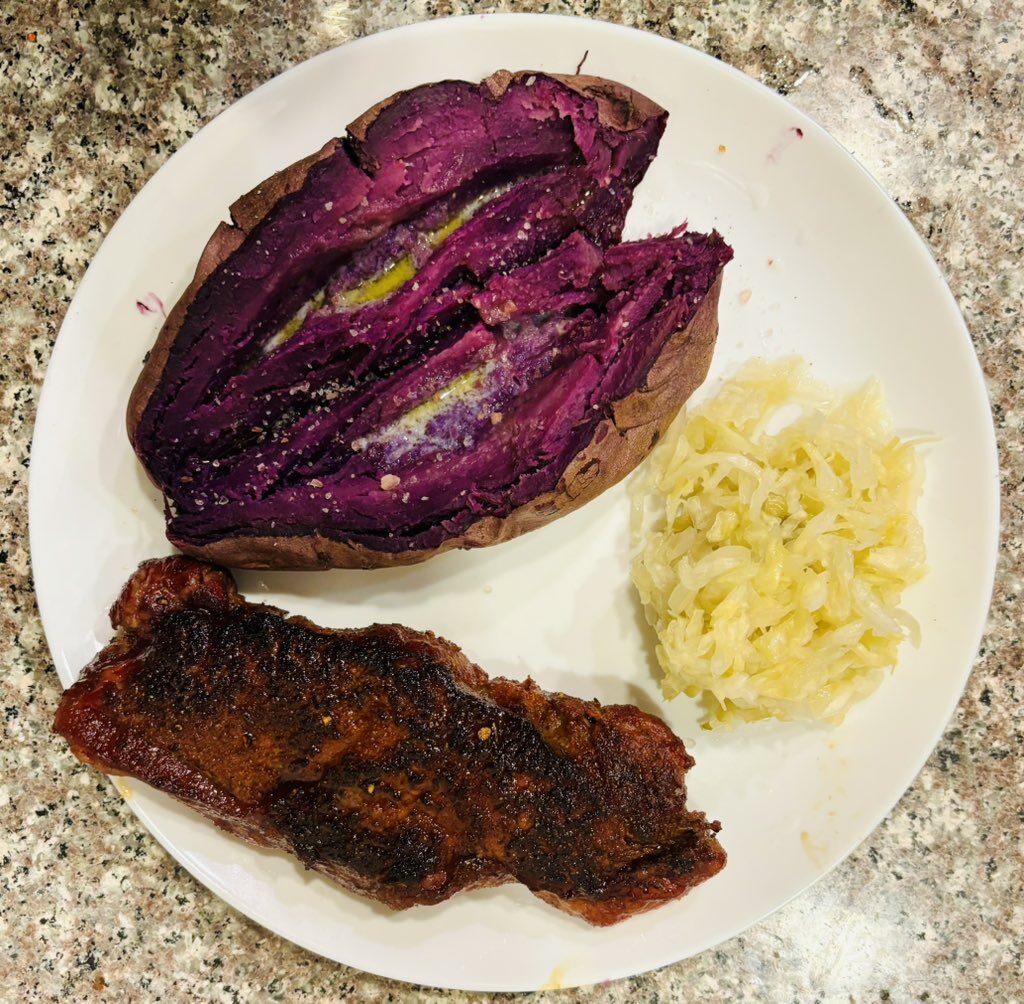
Sirloin with a purple sweet potato and sauerkraut. Red meat for protein and iron, sweet potato for carbs, and sauerkraut as my regular fermented food.
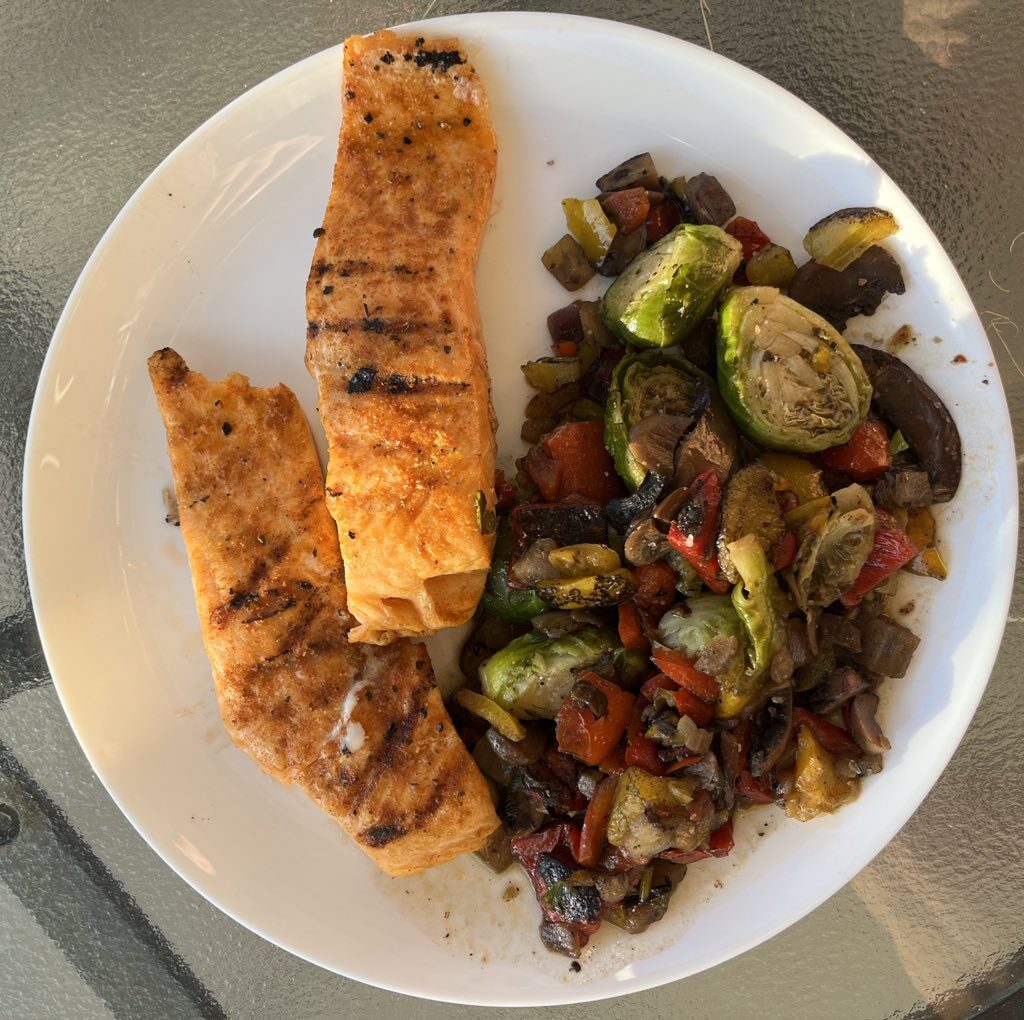
Salmon with Brussels sprouts and sautéed vegetables. Salmon is my main source of omega-3 fats, and the vegetables cover most of the fiber for the meal.
Every meal is built around a protein source, with vegetables or fruit filling out the rest of the plate. It adds up to roughly 2,500 to 2,800 calories a day, with around 125 grams of carbs, about 35 grams of which is fiber.
I also eat mostly grain-free. That one is personal, and I'll explain why in a separate post.
The principles behind it
Eat close to what you burn. I don't track every day. Every few months, I log everything I eat for a couple of days to check, and it always lands in the same range. That quick check keeps me honest without turning food into a math problem.
Repeat your meals. Eating the same handful of meals most of the time sounds boring, but it's the reason I don't need to track. When the meals barely change, the calories barely change either. It also means fewer decisions on busy days, which is when most people end up grabbing whatever's easy.
There's research behind this too. "Eat a wide variety of foods" is standard advice, but a review of 39 studies found that people eat more when a meal or diet offers more variety, and that greater variety was associated with higher body weight and body fat. A study of nearly 7,000 adults found that people whose diets mixed very different kinds of foods gained more around the waist over five years.
The effect comes mostly from variety in calorie-dense foods, like snacks, sweets, and rich dishes. Variety in vegetables and fruit is a different story, which is why I still eat a range of them. The point is to keep the core of your meals simple and repeatable.
Adjust fats, not carbs, when training changes. When my training load goes up, I add fats, like more olive oil, avocado, or a fattier cut of meat. When it drops, I pull them back a little. My carbs stay about the same. You might do it differently, but the point is to adjust one lever in small amounts instead of overhauling your diet every few weeks.
Pick foods for what's in them. I eat for nutrient density more than anything else: fish for omega-3s, pasture-raised eggs, fermented foods, a lot of berries, and extra virgin olive oil as my main added fat. When most of your calories come from foods like that, it's hard to overeat and easy to cover what your body needs.
One big meal doesn't undo a steady pattern. This Thanksgiving, I'm having eggs and fruit in the morning, rolling at open mat for two hours, then eating turkey, rib roast, sweet potatoes, Brussels sprouts with bacon, and my daughter's homemade pumpkin cheesecake. I'm not going to stress about it. The next day, I'll go back to my normal meals. The holiday meal isn't what decides how you look and feel. The ordinary days are.
How to make this work for you
Your meals and your numbers will be different from mine. A 5'6" woman and a 6'2" man shouldn't eat the same amount, and you may feel great on foods I avoid. But the pattern works for almost anyone.
1. Pick four or five go-to meals. Build each one around a protein source, then add vegetables, fruit, or a starch. Choose meals you actually like and can make on a busy weeknight.
2. Eat them most of the time. Aim for most of your meals, not all of them. Leave room for dinners out and holidays.
3. Check your intake every few months. Log everything for two or three days. If your weight is steady and your training is going well, you're in the right range.
4. Watch your waist and your strength, not just the scale. Measure your waist at the belly button and write it down next to a strength number, like your best push-up or pull-up set. Check both every couple of months. If your waist is growing faster than your strength, you're eating more than you need.
5. Adjust in small steps. When something needs to change, change one thing a little and give it a few weeks.
Next in this series
This is the first post in a series on how I eat at 47. Coming up: the nutrient-dense foods I build my meals around, why I eat mostly grain-free, how many carbs I eat and why, and how to figure out what works for your own body.
Want them in your inbox? Join the email list.
Keep reading
Stay capable,
JT
Sources
• Raynor and Epstein. Dietary variety, energy regulation, and obesity. Psychological Bulletin, 2001.
• de Oliveira Otto et al. Everything in moderation: dietary diversity and quality, central obesity and risk of diabetes. PLOS ONE, 2015.
• Phillips et al. Physiological adaptations to resistance exercise as a function of age. JCI Insight, 2017.
• Devarakonda et al. Relationship between fat-free mass and metabolic syndrome is shaped by ectopic fat in a UK Biobank cohort. The Journal of Clinical Endocrinology & Metabolism, 2026.
FAQ
How do you stay lean after 40 without dieting?
Eat close to what you burn most days, built around a handful of protein-centered meals you repeat. Check your intake for a couple of days every few months, and adjust in small steps instead of swinging between bulking and cutting.
Should you bulk after 40?
A big surplus is a poor trade for most people over 40. Muscle builds more slowly at this age, so more of the extra tends to end up as fat. A steady intake with consistent strength training is a better fit.
Do you need to count calories to stay lean?
Not every day. If you eat the same few meals most of the time, your intake stays fairly consistent. A short check every few months is usually enough to confirm you're on track.
Will one big holiday meal ruin your progress?
No. One meal is a small part of your week. What matters is getting back to your normal eating the next day.