
Why Your Body Stops Forgiving You After 40: An Evolutionary Explanation

JT
Nov. 16, 2026
Why Your Body Stops Forgiving You After 40: An Evolutionary Explanation
By Jerry Teixeira | Nearly 30 Years of Strength Experience
At 25, you could eat a huge surplus, sleep five hours, train sloppy, and still recover by Thursday. At 45, those same habits cost you more body fat, slower recovery, and nagging injuries.
There's a reason for that, and it comes from evolutionary biology.
In Part 1, I covered a study of 59,269 adults showing that more lean mass isn't automatically healthier after 40, especially when fat comes with it. This post covers the first reason 40-ish is a real turning point.
Evolution protects you while you're young
For the first half of your life, you had a partner looking out for you: natural selection.
Michael Rose is an evolutionary biologist at UC Irvine. He's spent over 40 years studying why we age, and his work explains how that partnership works.
His work builds on an idea called the force of natural selection, worked out mathematically by the biologist W.D. Hamilton in 1966.
Evolution has one priority: getting your genes into the next generation. So it protects you hardest when you're young, while you're growing up and having kids. A gene that kills you at 15 gets weeded out fast, because you never pass it on.
As you move through adulthood, that protection fades. A gene that causes problems at 50 barely gets noticed by evolution, because by then most people have already had their kids. By the end of the reproductive years, the force of natural selection is close to zero.
From evolution's point of view, once your genes are passed on, keeping you running is no longer the job.
It's like a marriage that went bad. Evolution got what it wanted from you, then left you for someone younger.
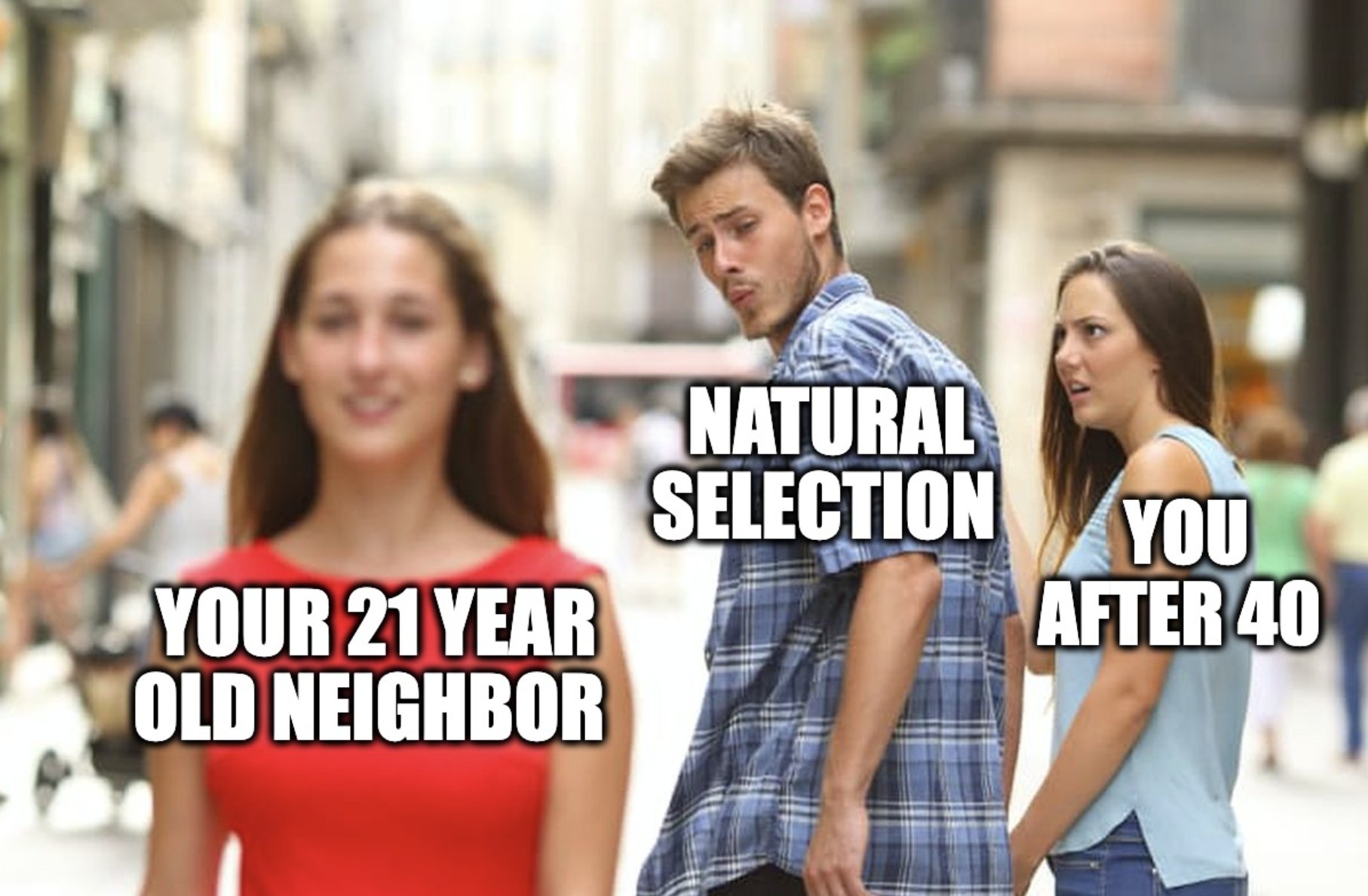
This doesn't happen on your 40th birthday like a switch. The protection fades gradually through adulthood. But by midlife, most of it is gone.
The bill comes due later
It gets worse.
Some genes help you when you're young and hurt you later. Biologists call this antagonistic pleiotropy, which is a fancy way to say "good now, bad later."
Evolution keeps those genes because the early benefit is what counts. Faster growth, earlier reproduction, more energy for having kids. The later cost doesn't get weeded out, because by then selection has stopped paying attention.
Rose's argument is that much of what we call aging is just the bill for those early-life advantages coming due.
The fruit fly experiment
Rose tested this in fruit flies, starting in the early 1980s.
Normally, flies breed young. So Rose's lab only let flies breed late in life, collecting eggs from older flies, generation after generation. Now evolution had a reason to keep them healthy longer.
It worked. Over many generations, those flies evolved to live much longer. Rose and his colleagues roughly doubled their lifespan, and the flies got healthier in other ways too. They called them Methuselah flies.
Other labs have repeated the result. A 2026 preprint using flies descended from Rose's original populations found that selecting for later reproduction reliably extends lifespan, and also improved stress resistance and immune defense.
Same species. Change when evolution cares, and you change how they age.
Great, but how does that help you?
You can't go back and change when your ancestors had kids. The experiments support a key prediction of Rose's theory. Selecting for later reproduction changed how the flies aged. But they don't hand you anything to use.
His diet experiments do.
The flies in Rose's lab descend from wild flies collected in a Massachusetts apple orchard in 1975. Their ancestral food was rotting apples. But in the lab, they'd been raised on banana-based food for hundreds of generations.
So his team fed some flies their ancestral apple diet and some their usual banana diet, then tracked how well they survived and reproduced as they aged.
Young flies did fine on banana. They had adapted to it. The difference showed up later in life, when the apple-fed flies held up better.
Here's why. Natural selection can adapt a species to new conditions, but it only does a thorough job at the ages it's paying attention to. While the flies were young, selection had tuned them to handle food their ancestors never ate. Later in life, that tuning ran out, and the mismatch started to show.
Rose's team suggested the same may apply to people. Someone whose ancestors farmed for thousands of years may handle a modern diet fine when young, but benefit from eating more like our distant ancestors later in adult life.
What this means at 45
You don't need to remember any of the science. You just need what it means for you.
At 25, your body was still under evolution's protection. It covered your mistakes.
• You could eat a huge surplus, and more of it went somewhere useful.
• You could sleep five hours and train anyway.
• You could do sloppy, high-volume workouts and recover by Thursday.
• You could drink on Saturday and feel fine Sunday.
At 45, that cover is mostly gone. The same habits can still work, they just cost more. More of the surplus goes to fat. Bad sleep shows up in your training. Junk volume turns into nagging injuries.
Rose's experiments tested diet. But the same logic applies to most of how we live now. Short sleep. Regular drinking. Sitting all day. Stress that never shuts off. Your body wasn't built for any of it, and after 40, natural selection isn't covering for you anymore.
And midlife is exactly when those things pile up. Most of us are working more than ever, in higher-stress jobs, with kids and sometimes aging parents to take care of. Sleep gets shorter. Training gets skipped.
That's why midlife is the time to take this seriously. You need to be more resilient right when life is demanding the most from you.
Maintenance is your job now
That's the bad news. The good news is simpler than it sounds.
Your old partner left, so maintenance is your job now.
You can't change your genes, but you can change how you train, eat, and recover. After 40, those choices carry more weight than they used to.
Here's what that looks like in practice:
Build strength that keeps you capable. Strength gains after 40 hold up well. Push, pull, squat, and hinge, done consistently.
If you’re just starting, my beginner’s guide to bodyweight training shows you how to put your first workout together.
Eat closer to how humans ate for most of our history. Mostly whole foods: meat, fish, eggs, vegetables, fruit. Less of the ultra-processed food your body has had the least time to adapt to.
Protect muscle quality, not just size. As Part 1 showed, more lean mass isn't automatically healthier. Stay lean enough that the muscle you build is working muscle.
Train for recovery, not exhaustion. Your margin for junk volume is gone. The Minimum Effective Dose, done well, beats a pile of sloppy sets you can't recover from.
Protect your sleep and go easy on alcohol. Both cut into recovery, and after 40 you have less recovery to spare.
After this series, I'll break down exactly how I eat and train at 47.
Coming up in Part 3
In Part 3, I’ll show you what new research says about when aging speeds up, including a widely shared study that just got flagged, and what still holds up.
The series
This is Part 2 of a three-part series on why 40 is a real turning point and not just a marketing scare tactic:
1. More muscle isn't always healthier after 40
2. Why your body stops forgiving you after 40 (you're here)
3. Aging speeds up in your mid-40s: what the research shows and what to do about it (coming soon)
Want the 8 movements I build every program around? Get the free Foundational 8 guide.
If you want a simple place to start, join the BWS newsletter.
You'll get the Foundational 8 guide, the eight movements that form the backbone of everything I teach.
No spam. Just actionable training intel when I've got something worth your time.
Stay capable,
JT
Sources
• Rose, Passananti, and Matos (editors). Methuselah Flies: A Case Study in the Evolution of Aging. World Scientific, 2004.
• Rutledge et al. Age-specific adaptation to diet in Drosophila. Rose lab, UC Irvine.
• Rutledge, Mueller, Cabral, and Rose. Evolutionary Biology of Diet, Aging, and Mismatch. Journal of Evolution and Health, 2018.
• Parallel adaptive responses to postponed reproduction increase lifespan and immune defense. bioRxiv preprint, 2026.
• UC Irvine News. Fly study solves scientific riddle, on the Rose lab's long-running fly populations.
• Hamilton, W.D. "The moulding of senescence by natural selection." Journal of Theoretical Biology, 1966.
Q and A
Why do we age, according to evolutionary biology?
Because natural selection protects you most while you're young and able to reproduce. As reproduction winds down, the pressure to keep you healthy fades. Genes that help early in life but cause harm later aren't weeded out.
Does aging really start at 40?
Not as a switch. Evolution's protection fades gradually through adulthood. But by midlife most of it is gone, which is why many people notice their bodies getting less forgiving in their 40s.
What are Methuselah flies?
Fruit flies that Michael Rose's lab at UC Irvine bred to reproduce only late in life, over many generations. Their lifespan roughly doubled, showing that the timing of selection shapes how a species ages.
Can you slow aging after 40?
You can't change your genes. But strength training, staying lean, sleep, and limiting alcohol all affect how well you function as you age, and their impact grows after 40.